
October 27, 2026
Spotted on the Mat: The Controlled Moves Worth Trying This Week
All posts · Health + Wellness · Yoga & Pilates
Listen up, hot babes. If your social feeds are looking anything like ours, they are currently serving a masterclass in precision, control, and immaculate mat energy. We spent the week doing the heavy lifting so you don't have to, scrolling through endless reels to spot the exact micro-adjustments and sculpting sequences worth testing out during your next studio session or living room flow. Consider this your VIP backstage pass to what the chicest instructors are teaching right now.
First up on our radar is an absolute game-changer for anyone who has ever stared at the ceiling during a hundred, wondering why their lower back is screaming while their abs remain entirely unbothered. Veteran instructor @pilates.by.cat stepped onto our screens this week with a masterclass on deep core connection that every single one of us needs to bookmark immediately.
For years, fitness culture has bullied us into gluing our lower backs completely flat against the mat like our lives depended on it. As @pilates.by.cat points out after over two decades in the trenches of teaching, flattening that spine entirely can actually work against you. It shifts the workload away from the transverse abdominis and straight into your superficial muscles and hip flexors. Instead, the secret lies in finding a neutral pelvis. Keep your hip bones and pubic bone level, let your ribs stay soft and connected, and honor the natural curves of your spine. Think of your transverse abdominis as an internal corset wrapping horizontally to support you from the inside out. Next time you roll out your mat, ditch the flat-back obsession and check your pelvic alignment first. Your lower abs will finally wake up, and your lower back will send you a thank-you note.
Speaking of transforming our relationship with our bodies, our feeds also delivered a gorgeous reminder of why we unroll our mats in the first place. Over at @yogawithilona_, the vibe shifted from pure mechanics to poetry.
Backbends can feel intimidating, especially if you treat them as a destination rather than a journey. But when you approach them with the same deep core awareness we learned from @pilates.by.cat, everything changes. Opening up the front body requires stability in the pelvis and length through the spine rather than just dumping weight into your lower back. It is about devotion, repeated effort, and finding that sweet spot where strength and softness meet.
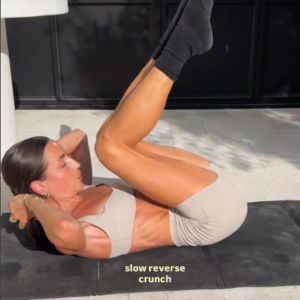
Of course, knowing the theory is only half the battle. To bridge the gap between aesthetic inspiration and actual sweat, we looked at how our favorite creators package endurance into bite-sized routines. Over at @burnandbliss, the focus dialed straight into a rapid, highly efficient abdominal sequence designed to test your stamina without requiring a sixty-minute commitment.
Taking inspiration from these brilliant creators, we have put together a signature blended flow to try this week. Think of it as your express ticket to a smarter, more controlled core workout.
- Neutral Pelvis Breathing Setup: Lie on your back with knees bent and feet flat. Inhale to expand your ribcage wide, and as you exhale, gently draw your internal corset inward without flattening your spine into the floor. Complete 10 intentional breaths.
- Modified Toe Taps: Maintaining that gorgeous neutral pelvis, float your legs to tabletop. Slowly lower one toe toward the mat, tap lightly, and return. Alternate sides for 12 to 15 slow repetitions per leg, keeping your lower back entirely quiet.
- Seated Spine Extension: Transition smoothly to a seated position, then press up into a gentle, supported backbend or bridge pose, keeping your glutes active and your ribs knitted down. Hold for 5 deep breaths.
- Sculpted Oblique Series: Switch to a side-lying or forearm support position, executing 10 to 15 controlled lifts per side, focusing entirely on length and slow tempo rather than raw speed. Rest for 30 seconds, then repeat the entire sequence for two full rounds.
Remember, besties, this is general movement education, not individual medical advice. Always choose controlled movements, stop immediately if you feel pain, dizziness, or unusual symptoms, and seek qualified professional guidance when dealing with injuries or pregnancy. Now grab your cute water bottle, adjust that pelvis, and go conquer the mat.